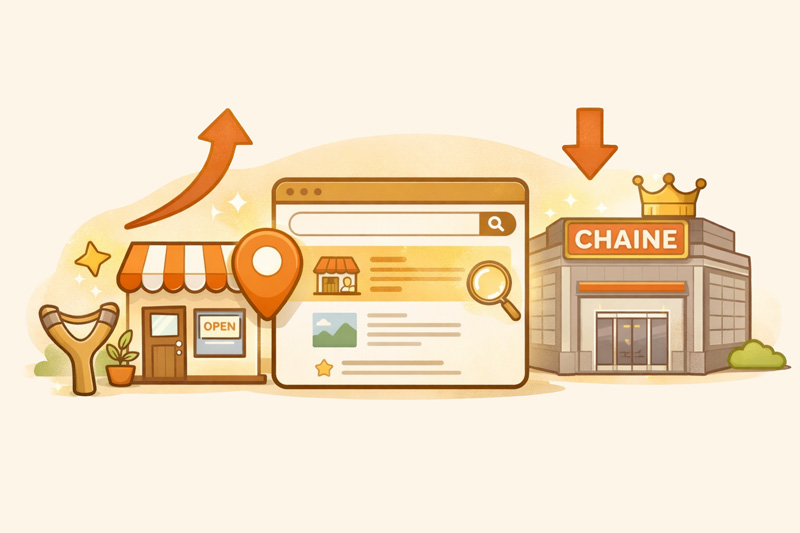
There's an industrial bakery that just opened two streets away from you, or a national garage franchise flooding the city with advertisements.
Your first reaction? Worry. "How am I going to fight against them? They have huge budgets, marketing teams..."
It's legitimate. But I have excellent news for you: you start with a head start on the field of local SEO.
Google's algorithm doesn't work like the real world. It doesn't necessarily favor the one with the most money, but the one that is the most relevant, close, and authentic.
Here is how to transform your "modest" size into your greatest strength.
❤️ 1. Google prefers "Real" to "Big"
Big chains have a major problem: they are impersonal. Their Google profiles all look alike, their responses to reviews are robotic copy-pastes, and their photos are stock images that look too perfect.
Google (and your customers) hate that.
As an independent business, you have a secret weapon: authenticity.
- Your photos are real: A photo taken with your phone showing your team working will always have more impact than a cold studio photo.
- Your responses are human: When you reply to a review, people can feel there is a real person behind it.
- Your story is unique: Fill your description with your story, your values.
Begonia.pro tip:
Don't try to look pro but 'slick', like the big brands. Be yourself. That's what people are looking for in a local business.
🛡️ 2. Local anchoring: your invisible shield
It's a secret that was confirmed by internal Google data leaks: Google places capital importance on a business's integration into its local fabric.
A big chain is "parachuted" into a city. You, you are rooted there.
To beat Goliath, you must prove to Google that you are THE reference in the neighborhood:
- Local citations: Get mentioned on the websites of the town hall, local associations, the local newspaper. These "links" (backlinks) are ultra-powerful for improving your online visibility. To learn more, read our dedicated article: understand the impact of local citations.
- Partnerships: A national franchise will never partner with the florist next door. You will. Mention each other.
Google sees these connections. It understands that you are "from the area", unlike the chain which is just one address among 150 others.
🏃 3. Reactivity: your speed vs their heaviness
In a large company, changing information or posting an update takes days of validation.
You? You can publish a Google Post in 2 minutes to announce that a slot has just opened up this afternoon or that you have just received a new expected product.
This agility is precious. Google loves profiles that are alive.
- Post regularly.
- Update your holiday hours before everyone else.
- Respond to reviews quickly.
While Goliath waits for headquarters validation, David has already attracted three new customers.
🎯 4. Don't fight on volume, but on precision
They might have more reviews than you in total, if they are bigger. But you can have better reviews.
Your ability to offer a tailor-made service will translate into longer, more detailed reviews containing valuable information ("Thanks for the quick repair of my boiler" vs "Good service").
This valuable information in reviews helps your SEO enormously.
👀 Conclusion: Watch them, but don't fear them
The arrival of a big competitor is not a fatality, it's a challenge.
Often, these large structures are very visible at the beginning (novelty effect + ad budget), but run out of steam quickly on service quality and local e-reputation management.
To keep your peace of mind, monitor what they do without spending your days on it.
With our competitor analysis tool, you can see in a glance:
- Their progression on Google.
- If they are receiving a lot of reviews.
- If they are buying ads.
Stay focused on your strength: being the local, close, and human expert. That's what Google wants, and mostly what your customers want.